If you’re a frontend developer struggling with tech choices in 2026 — I feel you.
React’s RSC, Next.js’s App Router, Vue’s Vapor Mode… every framework keeps piling on more stuff. Every new project starts with configuring webpack/vite/turbopack, then stares at thousands of node_modules files in despair.
Meanwhile, an opposite trend is quietly gaining steam.
Astro has more GitHub stars than Next.js. htmx is growing faster than React and Svelte. And Web Components — a technology people have been saying “will finally take off” for years — has found its niche in 2026: the Lit + Tailwind + Vite combo is now production-ready.
These three, jokingly called the “lightweight frontend trio,” are turning “less JavaScript” from a slogan into real engineering practice.
This isn’t another trend forecast piece. We’ll look at what each solves, when they’re worth using, and where you should start.

Why “Less JS” Suddenly Matters Again
Let’s set the stage.
For the past decade, frontend development has basically been JavaScript development. The SPA era turned JS from a “scripting language” into the foundation of entire applications — HTML and CSS were generated by JS, manipulated by JS, or entirely replaced by JSX/Vue Templates.
We told ourselves this was progress. Sure, React and Vue’s component model is way better than the jQuery era. But we went too far.
No JS? White screen. Before hydration finishes? Blank loading spinners. A simple blog page? Dozens of npm dependencies behind it. Crawlers can’t index it, screen readers can’t parse it, and on slow networks the whole site falls apart.
An InfoQ article put it well: “Developers became ops engineers — managing build pipelines, webpack config, bundlers, tree shaking, and hydration strategies.” The tools built to solve complexity had become the source of it.
So “less JS” isn’t nostalgia. It’s a rational correction.
Astro: A Static Site Generator With Zero JS By Default
Astro is one of the fastest-growing web frameworks in 2026. Its core idea is simple: output pure static HTML by default, and only load JavaScript where interaction is needed.
What does that mean? When you write an Astro page, it’s clean HTML + CSS by default. If a component needs interaction (like a counter), you add a `client:load` directive. Astro bundles that component separately and activates it only in the browser. The rest stays static.
This is the “Islands Architecture” — most of the page is static “ocean,” with only a few interactive components as dynamic “islands.”
Compare the old way:
– Building a blog with Next.js: the entire page is a React component, requiring server rendering + client hydration. Even if only one search box needs interactivity, you ship the entire React runtime to the browser.
– Building the same blog with Astro: 99% of the content is pure HTML. Only the search box component loads React.
For content-focused sites, this is a huge win.
Astro isn’t tied to any UI framework. You can use Vue, Svelte, React, or Lit Web Components — it supports them all. It’s genuinely framework-agnostic.
When to use it
Content sites, blogs, documentation, marketing pages, e-commerce product pages. If you’re debating Next.js vs Astro, a simple rule: if more than 80% of your pages are static content, go with Astro.
Learning curve
You don’t need to learn a new syntax. Astro’s template syntax is very close to HTML. A `.astro` file looks like HTML with a `—` delimited server script section. If you know React or Vue, you’ll be productive in half an hour.
htmx: AJAX Without JavaScript
htmx might be 2026’s most controversial yet fastest-growing library.
Its small base is part of it, but the growth rate tells you something: developers are fed up with shipping an entire React app just to handle a click event.
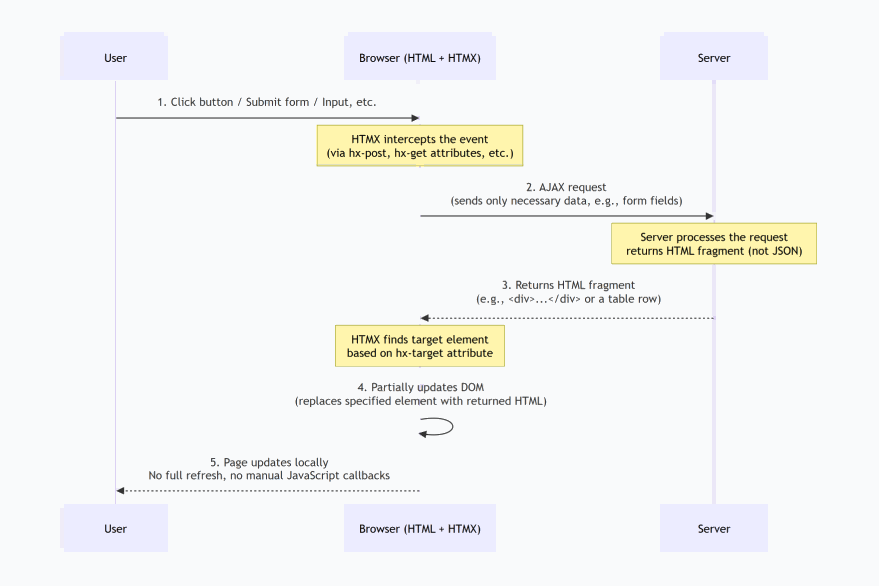
htmx’s philosophy is “hypertext-driven development” — you add attributes to HTML tags and get AJAX requests, form submissions, real-time updates, even WebSocket communication.
Here’s a live search example:
<p>
<input type="text" name="q" hx-get="/search" hx-trigger="keyup changed delay:500ms" hx-target="#results" placeholder="search..."></p>
<div id="results"></div>
With these few attributes, when the user types, 500ms later it sends a GET request to `/search` and stuffs the returned HTML into `#results`. Not a single line of JavaScript.
The backend returns HTML snippets, not JSON. So your server-side framework (Django, Laravel, Rails, Spring Boot) can render templates directly, and the frontend doesn’t need a separate API handling layer.
Where it shines
– Backend-led projects: the backend engineer wants to add some interactivity without touching React/Vue
– Internal tools and admin panels: no complex client-side state management needed
– Progressive enhancement: adding dynamic features to existing server-rendered pages
When to skip it
– Scenarios requiring complex client state management (online spreadsheet editors, design tools)
– High real-time demands (drag-and-drop, collaborative editing)
The htmx website has a self-deprecating essay called “htmx sucks” that honestly admits: htmx isn’t a silver bullet. But it handles about 80% of everyday interactivity needs. The remaining 20%? Use a full JS framework. That’s a realistic take.
Web Components: Finally Finding the Right Use
Web Components have been criticized for years — low-level API, awkward template syntax, Shadow DOM incompatibility with framework ecosystems. Most of that criticism is fair.
But things changed in 2026. Two key developments.
One: Lit made Web Components usable.
Lit, maintained by Google, wraps the low-level custom elements and Shadow DOM APIs into a clean interface:
import { LitElement, html, css } from 'lit';
import { customElement, property } from 'lit/decorators.js';

@customElement('my-button')
export class MyButton extends LitElement {
    @property({ type: String }) label = 'click me';

    render() {
        return html`<button>${this.label}</button>`;
    }
}
Then you can use `
Two: Tailwind + Vite + TypeScript closed the engineering gap.
Early Web Components development felt primitive. But with Lit + Tailwind + Vite + TypeScript, the developer experience rivals React. Paired with routing/state libraries like Suunta, you can even build full SPAs.
My take: Web Components are best suited for cross-framework UI component libraries. If you maintain a project that uses both React and Vue, or you’re building a design system, Web Components are the natural choice because they’re framework-agnostic.
But if your project already uses React or Vue with no cross-framework requirement, stick with your framework’s component system — no need to switch for the sake of it.
## How the Trio Works Together
These aren’t a binary choice — they’re complementary:
| Scenario | Recommended Stack | Why |
|---|---|---|
| Content sites | Astro + a few Lit components | Astro’s zero-JS by default, Lit handles interactivity |
| Admin panels | htmx + server-side framework | Fast delivery, minimal frontend code |
| Cross-framework UI libs | Web Components (Lit) | Truly framework-agnostic, write once use everywhere |
| Hybrid applications | Astro + htmx + Lit | Astro for architecture, htmx for dynamic interactions, Lit for reusable components |
A practical workflow: the whole site is built with Astro, most content is pure HTML + CSS. For server-interaction parts (search, forms, pagination), use htmx. For reusable UI components (buttons, modals, tables), write Web Components with Lit.
Most of your code ends up being HTML and CSS. JavaScript appears only where it’s genuinely needed. The project runs fast and stays stable.
Should You Jump In Now?
The answer depends.
If you’re building content-focused projects (blogs, documentation, corporate sites, personal pages), Astro is worth adopting right now — much simpler than Next.js, with better performance.
If you primarily write backend code (Python/Django, PHP/Laravel, Ruby on Rails), htmx lets you build decent interactive experiences without touching JavaScript. Spend a weekend trying it out.
If you maintain a cross-framework component library or design system, Web Components (Lit) are the only forward direction. Stop writing separate components for React and Vue.
But if you’re building a heavily interactive client-side app (online IDE, design tool, real-time collaboration platform), stick with React or Vue. They’re still the best choice for that. Lightweight isn’t a silver bullet.
Final Thoughts
Frontend technology has gotten more complex each year. But we’ve gradually realized: users don’t care whether your tech stack is cutting edge. They care whether the page loads fast and interactions feel smooth.
The rise of the “lightweight trio” is essentially a collective reflection on “JavaScript overreach.” It’s about going back to pure static sites, but about letting JavaScript play its original role — showing up where it genuinely enhances the experience, rather than becoming a burden on it.
This isn’t regression. It’s the frontend community finally learning to say no to its own impulses.
If you haven’t tried any of these three, start with Astro. Experience the pleasure of “zero JS by default” — it will change how you think about frontend performance.
—
📖 Recommended Reading
Take a look at these articles; you might find them interesting
React Compiler 1.0 Is Here: Can We Finally Delete useMemo and useCallback?
TensorFlow.js: A Practical Guide to Running AI in the Browser
The 2026 Frontend AI Toolbox: A Practical Workflow for Daily Coding, Refactoring, and Debugging
