Why Multi-Agent Orchestration?
Most AI agent demos you’ve seen are single-agent loops. One model, one context window, one tool set, one task. That works fine for simple scenarios. But when complexity ramps up, a single agent runs into three walls that orchestration is designed to break through:
– Context window limits . Thousands of pages of legal contracts, a codebase with millions of lines, research spanning hundreds of documents. No single context window can hold all that — orchestration splits the load across agents.
– The specialization gap. Asking one general-purpose model to do research, writing, and code review means it’s mediocre at everything. You’re better off with three specialized agents each owning their domain. This is where orchestration pays off: routing each sub-task to the right specialist.
– Wasted serial execution. Running sub-tasks sequentially when they have no dependencies is just throwing time away. A parallel pattern fixes this trivially.
Gartner reports a 1445% surge in enterprise inquiries about multi-agent systems between Q1 2024 and Q2 2025. The less flattering number: 40% of multi-agent pilots fail within six months of production deployment. Two reasons — picking the wrong orchestration pattern, or picking the right orchestration pattern without understanding how it breaks under real load.
This article breaks down the most common production-grade orchestration patterns: sequential chain orchestration, fan-out/fan-in orchestration, supervisor/worker orchestration, hierarchical delegation orchestration, multi-agent debate orchestration, dynamic handoff orchestration, and adaptive planning orchestration. For each pattern, I’ll cover the architecture, when to use it, real-world examples, framework implementation notes, and the gotchas that bite you in production.
Before we dive in, ask yourself one thing: do you actually need multi-agent orchestration? Princeton NLP found that a single agent matched or outperformed multi-agent systems on 64% of benchmarked tasks given the same tools and context. Multi-agent orchestration adds roughly 2.1 percentage points of accuracy at roughly double the cost. Only reach for orchestration when you hit at least one of those three walls.
Pattern 1: Sequential Chain Orchestration
Architecture
The simplest multi-agent pattern. Agents execute in a fixed order — each agent’s output becomes the next agent’s input. Think assembly line: raw material in one end, finished product out the other. State flows strictly forward in this orchestration topology.
```
 Input
 ↓
 [ Agent A: Research ] → research_output
 ↓
 [ Agent B: Synthesis ] → synthesis_output
 ↓
 [ Agent C: Format/QA ] → final_output
 ↓
 Output
 ```
Every agent sees the accumulated context from all previous stages. State flows down the chain.
When to use it
This sequential orchestration pattern fits scenarios where each step depends on the complete output of the previous step, and the task has a natural linear progression. Canonical use cases:
– Document processing pipelines: extract → analyze → summarize → format
– Customer support escalation: classify → retrieve context → draft response → quality check
– Content production pipelines: research → outline → draft → edit
Real-world example
Anthropic’s internal research summarization pipeline is a textbook sequential example: a retrieval agent fetches relevant papers, a distillation agent extracts key findings, a synthesis agent identifies contradictions and consensus, and a formatting agent produces a structured report. Strict sequencing ensures each stage has complete context before moving forward.
LangGraph implementation notes
In LangGraph, a sequential graph has no conditional edges and no parallel branches. Each node modifies a typed state object and passes it to the next. The framework automatically checkpoints between nodes — if a node fails, the chain can resume from any intermediate state. Use `StateGraph` with `add_edge(a, b)` rather than `RunnableSequence`, which lacks checkpointing and isn’t suitable for production.
Watch out for: context bloat. State accumulates quickly. Every agent appends its full output, and by the time you reach Agent C, you might be feeding 50,000+ tokens of context when you only needed 2,000. Prune aggressively between stages — pass only what the next agent actually needs.
Pattern 2: Parallel Fan-Out / Fan-In Orchestration
Architecture
Decompose a task into independent sub-tasks, dispatch them to multiple agents in parallel (fan-out), wait for all results, then merge them through a reducer (fan-in). This pattern drops total latency to roughly 1/N of sequential execution.
```
 Input
 ↓
 [ Decomposer ]
 / | \
 [ A1 ] [ A2 ] [ A3 ] ← parallel execution
 \ | /
 [ Reducer / Fan-In ]
 ↓
 Output
 ```
When to use it
This parallel pattern shines when the input can be cleanly split into independent chunks (no shared state, no ordering dependency), the sub-tasks have roughly equal cost (otherwise the slowest one determines total latency), and the results can be meaningfully merged. Typical use cases:
– Cross-document analysis (assuming independent documents)
– Multi-market research
– Parallel hypothesis testing
– Simultaneous API calls to multiple data sources
Real-world example
LangChain’s internal team benchmarked a competitive analysis pipeline profiling 12 companies. Sequential: 47 minutes. 4-way parallel: 13 minutes. The reducer agent normalizes outputs, resolves conflicting data points, and assembles the final matrix. The only extra complexity was a timeout policy: if an agent exceeds 3 minutes, the reducer marks it as “data unavailable” and continues rather than blocking on all results.
Orchestration implementation notes
In LangGraph, fan-out uses `Send` — a special edge type that dynamically creates parallel branches at runtime. Fan-in uses reducer functions in the state schema that specify how to merge concurrent writes to the same field. CrewAI supports parallel execution through async task configuration, but lacks fine-grained control over reducer logic. For raw Python, `asyncio.gather()` with a wrapper that catches and logs individual failures is the baseline.
Watch out for: uneven task sizing. If Agent A1 finishes in 8 seconds but A3 takes 90 seconds (rate limit hit, harder chunk), your total latency is 90 seconds — worse than the parallelism overhead. Always implement time-boxing with graceful degradation: agents that exceed the threshold return partial results, and the reducer explicitly handles gaps. Good orchestration designs always plan for stragglers.
Pattern 3: Supervisor / Worker Orchestration
Architecture
A supervisor agent dynamically assigns tasks to a pool of worker agents, monitors their outputs, and decides whether to accept, retry, or reassign. The supervisor is the single control point; workers are interchangeable executors. This pattern separates decision-making from execution.
```
 Input
 ↓
 [ Supervisor Agent ]
 / | \
 [ W1 ] [ W2 ] [ W3 ] ← worker pool
 \ | /
 [ Supervisor: eval + route ]
 ↓ ↓
 [ Accept ] [ Retry / Reassign ]
 ```
When to use it
Supervisor/worker works well when you have a homogeneous pool of agents doing similar work (research, code generation, data extraction), quality is variable and needs gating, or tasks arrive dynamically and need load balancing. The key difference from fan-out: the supervisor makes dynamic decisions based on worker output, not just a static merge. This makes it the preferred orchestration pattern for quality-sensitive workflows.
Real-world example
Cognition’s Devin architecture follows this pattern. The orchestrator continuously evaluates the coding agent’s output against a test suite. When tests fail, the supervisor doesn’t blindly retry — it routes back to the coding agent with specific error context. The supervisor holds the success criterion (all tests pass), the worker holds the generation capability. This separation makes debugging and improvement independent.
LangGraph implementation notes
The supervisor is a conditional-routing node: it reads worker output and routes to “accept” (terminal), “retry same worker,” or “reassign to different worker.” This pattern is LangGraph’s sweet spot. The `Command` primitive is designed for exactly this kind of routing — the supervisor returns a `Command(goto=”worker”, update={…})` that both updates state and controls routing. Set `recursion_limit` on the graph to prevent infinite retries.
Watch out for: supervisor hallucinations about quality. If the supervisor’s quality gate is itself LLM-based, it can hallucinate acceptance of bad output (“looks correct!”) or rejection of good output. Ground quality checks in deterministic signals wherever possible — test suite pass/fail, schema validation, confidence scores, checksums — not another LLM’s opinion. This failure mode is specific to LLM-based orchestration and doesn’t exist in deterministic workflow systems.
Pattern 4: Hierarchical Delegation Orchestration
Architecture
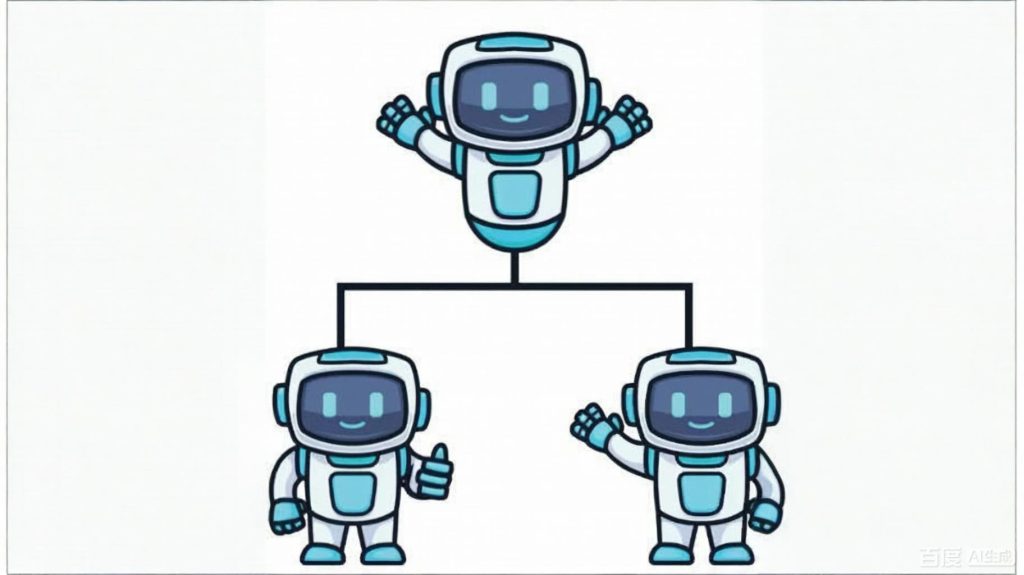
A top-level orchestrator delegates tasks to domain-specific sub-supervisors, each managing their own worker pool. Multiple control layers, each operating at the right abstraction level for their domain.
```
 [ Top Orchestrator ]
 / \
 [ Research Lead ] [ Engineering Lead ]
 / \ / \
 [ R1 ] [ R2 ] [ E1 ] [ E2 ]
 ```
When to use it
This orchestration topology makes sense when domains are genuinely heterogeneous (research, coding, legal review need different tools, models, and evaluation criteria), when scale demands it (100+ agents would be unmanageable under a single supervisor), or when different domains have different SLAs and risk profiles needing separate governance.
Real-world example
OpenAI’s internal “full-stack agent” experiments use a top-level planning agent that delegates to a research sub-system and a coding sub-system. The research sub-system coordinates multiple web-browsing agents and a synthesis agent; the coding sub-system manages a code generation agent, a test execution agent, and a debugging agent. The top orchestrator never touches individual tools — it reads summarized outputs from each sub-system and decides what to ask for next. This layered orchestration mirrors how engineering teams are organized.
Pattern 5: Multi-Agent Debate
Architecture
Multiple agents engage in a shared conversation, contributing perspectives, challenging each other, and refining positions across rounds. A practical variant is the maker-checker loop: one agent generates, another validates, repeating until approved.
When to use it
Compliance reviews needing multiple expert perspectives. Quality assurance with structured verification. Research shows multi-agent debate reduces hallucinations more effectively than single-model queries — agents catch each other’s mistakes. A cost optimization trick for this pattern: use a cheap lightweight model for the maker and a capable model for the checker. You get the quality improvement of debate at 40-60% lower cost than running both on capable models.
Watch out for: infinite debate. Agents may never converge. Microsoft recommends limiting group chat to 3 or fewer agents. A subtler problem is sycophancy cascading — agents tend to agree with the majority even when it’s wrong. Five rounds with three agents means 15 LLM calls per task, and the result can still be confidently incorrect because the agents reinforced each other’s errors. Always set a max iteration bound.
Pattern 6: Dynamic Handoff
Architecture
Each agent assesses the current task and decides whether to handle it or transfer control to a more appropriate specialist. Unlike supervisor/worker, there’s no central coordinator — agents delegate to each other based on runtime context. Only one agent is active at a time.
When to use it
Best for scenarios where the need emerges dynamically during the conversation — like a customer support ticket that starts as a billing issue and turns out to be a technical problem. You don’t know which specialist you’ll need until the conversation unfolds.
Watch out for: infinite handoff loops. Agent A passes to B, B passes to C, C passes back to A. This is the number one failure mode across all decentralized patterns. Every agent keeps replanning because nobody actually owns the task. Context loss compounds with every transfer. Either pass full context (expensive and eventually exceeds windows) or summarize (lossy, with accumulated errors degrading quality). Routing is non-deterministic — the same input can produce wildly different agent chains, making debugging nearly impossible.
Pattern 7: Adaptive Planning
Architecture
A manager agent dynamically builds, refines, and executes a task plan by consulting specialists along the way. Unlike supervisor/worker where the plan is predefined, here the plan itself is “discovered” through collaboration. The manager iterates, backtracks, and adjusts, continuously checking whether the original goal is met.
When to use it
Open-ended problems with no predetermined solution path. Incident response where remediation steps emerge from diagnosis. Complex migrations where scope changes during execution.
Watch out for: slow convergence. This pattern trades speed for correctness. Goal drift is the production killer — after multiple iterations, the manager’s refined plan can diverge significantly from the original intent. Backtracking makes things worse: when a dead end is discovered, all work from that branch is wasted compute, and the cost is impossible to predict upfront. If the original request is vague, the manager can loop indefinitely trying to build a “complete” plan for an underspecified goal.
How to Pick the Right Pattern
Quick decision guide for choosing your pattern:
– Known task decomposition → Supervisor/Worker. You know the sub-tasks ahead of time and want a single point of accountability.
– Fixed linear steps → Sequential Chain. Execution order is fixed and each step depends on the previous output.
– Independent parallel work → Fan-Out/Fan-In. Four or more tasks with no dependencies between them.
– Need quality verification → Multi-Agent Debate. Especially maker-checker loops where accuracy matters more than speed.
– Unpredictable routing → Dynamic Handoff. You can’t know which specialist is needed until runtime.
– Open-ended problem → Adaptive Planning. The plan itself needs to be discovered, not just executed.
One final thought: the most expensive orchestration pattern is the one you don’t need. Start with the simplest approach that fits your problem. Only upgrade to more complex orchestration patterns when performance testing or real operation proves you’ve hit a bottleneck. Princeton NLP’s finding is worth keeping in mind — a single agent is no worse than multi-agent orchestration on 64% of tasks. Is a 2.1% accuracy gain worth double the cost? Ask your use case, not the hype.
📖 Recommended Reading
Take a look at these articles; you might find them interesting
- OpenAI Teams Up with Five Chip Giants to Release MRC Protocol: Finally, a Fix for AI’s Network Bottleneck
- What Is Dify? The Open-Source AI App Platform Every Developer Should Know
- Run Open-Source LLMs Locally: From Ollama to DeepSeek and Build Your Private AI
- TensorFlow.js: A Practical Guide to Running AI in the Browser
