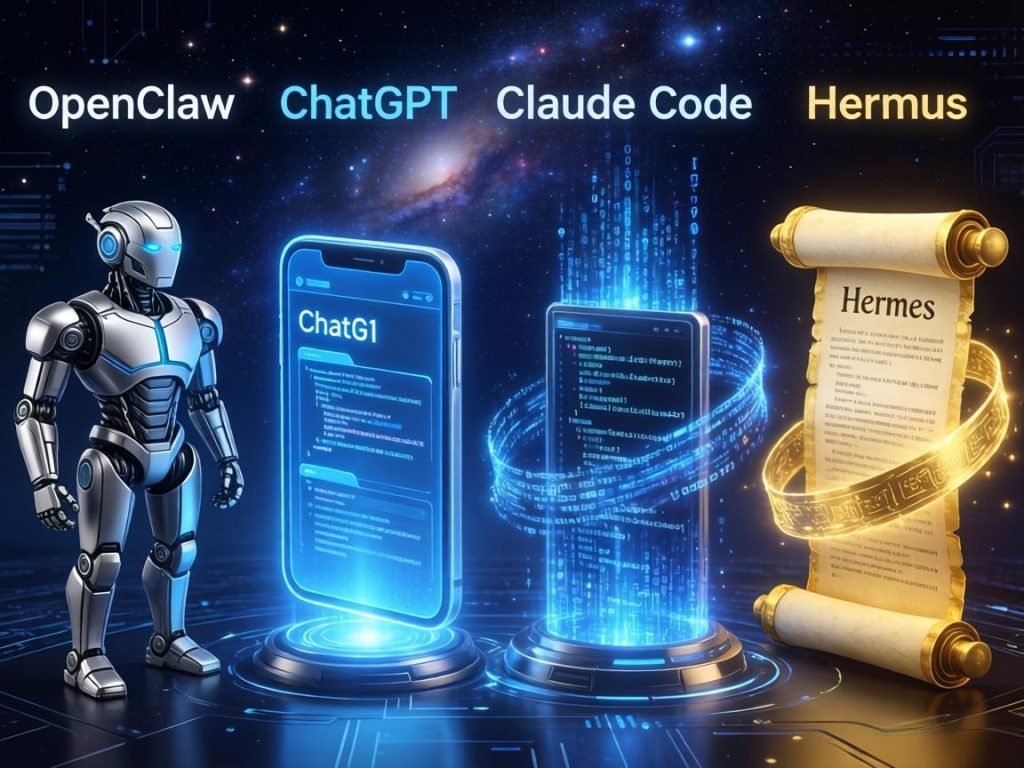
The AI tool landscape in 2026 has become incredibly rich. ChatGPT remains the most recognizable name. Claude Code is redefining AI-powered development. OpenClaw and Hermes represent a new generation of “autonomous agent frameworks.”
But here’s the truth: **these tools are not the same category.** Comparing them is like comparing a racing car to a boat—both are “vehicles,” but their design philosophies and use cases are worlds apart.
This article breaks down the comparison across **four core dimensions**: execution model, memory system, tool ecosystem, and deployment model.
—
What Is Each One?
ChatGPT: The Conversational Generalist
ChatGPT is what most people picture when they hear “AI.” Open a browser tab, type a question, get an answer. Excellent at reasoning, writing, analysis, and multimodal tasks.
**The core limitation**: It’s passive. It sits there waiting for you to talk to it. It can’t check your inbox at 3 AM or monitor your deployment status every 30 minutes and notify you.
ChatGPT is a brilliant conversationalist trapped in a browser tab.
Claude Code: The Agentic Developer Tool
Claude Code is Anthropic’s terminal-native AI coding agent. It reads your entire codebase, runs shell commands, manages git workflows, and executes complex multi-step development tasks autonomously.
Compared to Codex, Claude Code already possesses some Agentic capabilities—a **plan, execute, reflect, refine** loop.
But its design goal is clear: **serve developers writing code.** It won’t manage your calendar, summarize your meetings, or follow up on overdue tasks.
OpenClaw: The 24/7 Always-On Agent
OpenClaw is the star of this article and operates at a **fundamentally different architectural level** from tools like ChatGPT and Claude Code.
Its core features:
– **Runs 24/7 on your own hardware**, not in a browser tab
– **Connects to everything**: email, calendar, Slack, databases, file system, browser, 5,700+ community Skills
– **Cross-session persistent memory**: remembers decisions, preferences, and project status from weeks ago
– **Proactive execution**: can monitor, check, and execute tasks without you asking
– **Multi-model support**: Claude, GPT-4o, DeepSeek, Gemini, local models via Ollama
– **Fully local**: your data never leaves your machine
Hermes: The Self-Learning Open-Source Agent
Hermes is OpenClaw’s direct competitor with a different angle. Its core differentiator is a **built-in learning loop**—the agent reflects on its own outputs and improves over time based on what works.
Best for:
– Tasks where quality improves with iteration
– Wanting the agent to auto-update its own instructions based on results
– Something lighter than OpenClaw but more opinionated than raw Claude Code
The tradeoff: smaller community, earlier stage. Edge cases mean you’re more on your own.
—
Deep Comparison: Four Core Dimensions
1. Execution Model
| Tool | Execution Model | Description |
|---|---|---|
| ChatGPT | Reactive | Waits for your input to respond |
| Claude Code | Session-based Agentic | Autonomous multi-step operations within a terminal session, but stops when session ends |
| OpenClaw | Proactive 24/7 | Long-lived daemon process, task scheduling + event-driven |
| Hermes | Proactive 24/7 | Similar to OpenClaw, with self-improvement loop |
**Key difference**: ChatGPT and Claude Code are **session-driven**—human initiates, AI responds, round ends. OpenClaw and Hermes are **event-driven + time-driven**—you can have it check server logs at 3 AM and deliver a report at 8 AM.
2. Memory System
The “memory wall” problem is real for AI agents—every session starts fresh, wiping previous context.
| Tool | Cross-Session Memory | Notes |
|---|---|---|
| ChatGPT | Limited | OK within session, essentially none across sessions |
| Claude Code | Manual setup | No built-in, but solvable via auto-memory file patterns |
| OpenClaw | Native | MEMORY.md + structured state store, typed fields, versioning, hooks |
| Hermes | Native + Learning Loop | Built-in memory + self-reflection for quality improvement over time |
**Real-world take**: Non-framework Claude Code solutions (writing JSONL or Markdown) cover ~80% of lightweight memory needs. But you need to manually load memory files at session start. OpenClaw and Hermes make this infrastructure—you never think about “when to read, when to write.”
3. Tool Ecosystem & Connectivity
| Tool | Ecosystem Size | What Can It Connect To |
|---|---|---|
| ChatGPT | GPT Store | Plugins (limited), mostly cloud-based |
| Claude Code | MCP + Skills | File system, shell, APIs |
| OpenClaw | 5,700+ ClawHub Skills | Email, Slack, Linear, databases, browser, WordPress, Tencent Docs… |
| Hermes | Early stage | Core functionality extensible, far fewer integrations |
OpenClaw’s Skill ecosystem is its strongest competitive advantage. Need your agent to manage WordPress, check weather, search the web, send emails—ClawHub has ready-made Skills.
4. Deployment & Privacy
| Tool | Deployment | Data Privacy | Cost |
|---|---|---|---|
| ChatGPT | Cloud | Data on OpenAI servers | $20/mo+ |
| Claude Code | Terminal + Cloud API | Code sent to Anthropic | Usage-based |
| OpenClaw | Fully local | Data never leaves your machine | Free (+ model costs) |
| Hermes | Local + API | Local, can use local models | Similar to OpenClaw |
OpenClaw’s privacy advantage is structural—it’s not about policy choices, **the architecture simply doesn’t require your data to leave your machine.** You can even run fully offline with Ollama.
—
Side-by-Side Comparison
| Feature | ChatGPT | Claude Code | OpenClaw | Hermes |
|---|---|---|---|---|
| Execution Model | Reactive chat | Session Agentic | Proactive 24/7 | Proactive + Self-learning |
| Persistent Memory | ❌ Limited | ⚠️ Manual setup | ✅ Native | ✅ Native + Learning Loop |
| Runs Locally | ❌ | ✅ Terminal | ✅ Fully local | ✅ Fully local |
| Multi-Model | ❌ GPT only | ❌ Claude only | ✅ Any model | ✅ Multi-model |
| Scheduled Tasks | ❌ | ✅ Via Routines | ✅ Strong (with retry) | ⚠️ Limited |
| Skill Ecosystem | Plugins (limited) | MCP/Skills | ✅ 5,700+ | ❌ Early |
| Multi-Channel Input | ❌ | ❌ | ✅ Telegram/Email/Webhook | ⚠️ Limited |
| Setup Complexity | Zero | Low | Moderate | Moderate |
| Primary Use Case | Chat/Writing/Analysis | Coding/Development | Full life/work automation | Iteration/optimization |
| Data Privacy | Cloud | Hybrid | Fully local | Fully local |
—
How to Choose
**Choose ChatGPT:**
You just need a smart brain to chat with, write, and brainstorm. No system access needed, no background execution required.
**Choose Claude Code:**
You’re a developer needing an agent to write code, refactor, debug, and manage git. No need for calendar and email management.
**Choose OpenClaw:**
You need a **24/7 always-on personal assistant**—manage inbox, monitor services, follow up on tasks, operate WordPress, automate daily workflows. You have a server or NAS to run it long-term. You value data privacy and don’t want sensitive information on any cloud platform.
**Choose Hermes:**
Your needs are similar to OpenClaw’s, but you specifically want **self-evolution capability**—an agent that learns from every interaction and automatically optimizes its performance. You’re comfortable with a smaller community and fewer ready-made integrations.
—
OpenClaw vs Hermes: Head to Head
Since these are the hottest “autonomous agent frameworks” right now:
| Dimension | OpenClaw | Hermes |
|---|---|---|
| Open Source | ✅ MIT License | ✅ Open Source |
| Core Differentiator | Structured state + huge Skill ecosystem | Self-improvement learning loop |
| Setup Complexity | Moderate | Moderate |
| Community Size | 100K+ GitHub Stars, massive | Smaller, early stage |
| Enterprise Integrations | Mature (Linear, Slack, email, etc.) | Limited |
| Learning Loop | ❌ (relies on Skills + Heartbeat) | ✅ Built-in |
| Best For | Full-stack automation, multi-channel, production | Tasks needing continuous improvement |
Simple heuristic: **If you need 20 integrations and 50 automations, OpenClaw has them ready. If you have one critical task that needs to keep getting better, try Hermes.**
—
Conclusion
ChatGPT and Claude Code solve the “give me a smart brain to ask questions” mental model. OpenClaw and Hermes solve the “give me a reliable employee that gets things done on its own” mental model.
**From Q&A to autonomous action—this is the watershed moment in 2026 AI tool evolution.**
Still undecided? Here’s my simple advice:
– **Start with ChatGPT / Claude Code**—low barrier to entry, immediately validate if AI has value for you
– **Repetitive tasks eating your time**—go with OpenClaw
– **Want your agent to get smarter over time**—check out Hermes
Investing time in the right tool matters far more than agonizing over which tool to pick.
—
References
– [OpenClaw vs ChatGPT vs Claude: Differences & Use Cases – Pickaxe](https://pickaxe.co/post/openclaw-use-cases-what-makes-it-different)
– [Claude Code vs OpenClaw: Do You Need a Separate Agent Framework? – MindStudio](https://www.mindstudio.ai/blog/claude-code-vs-openclaw-agent-framework/)
– [Hermes Agent vs OpenClaw: Key Differences – LinkedIn](https://www.linkedin.com/posts/craig-hewitt-78386a66_ive-been-using-the-hermes-agent-for-a-month-activity-7444763922680795137-YWv2)
– [OpenClaw Official Site](https://openclaw.ai)
– [Claude Code Documentation](https://claude.ai/code)
📖 Recommended Reading
You can take a look at articles related to AI security
“Hermes Agent: The Deepest Dive into 2026’s Most Promising AI Agent Framework”

This is a thoughtful take on openclaw vs chatgpt vs claude code vs hermes: showdown. The practical examples really help illustrate the concepts.
gemini omni flash
This is a fascinating breakdown of the agent landscape. While ChatGPT and Claude Code excel in their respective conversational and coding niches, the real shift is toward persistent, autonomous execution. For creators pushing the boundaries of generative media, the workflow demands tools that operate beyond a single session. If you are looking for a studio that embodies that proactive, high-fidelity spirit, check out the independent video generation platform at MiniMaxH3. It delivers native 1440p output with advanced reference features, bridging the gap between raw model capability and a polished, always-on production pipeline.
The AI tool comparison is solid, but here’s a practical gap: none of these tools can cleanly edit text inside an existing image. That’s exactly where Imagelier comes in. It’s a free online editor that detects text regions in screenshots, posters, or product images, removes the original words, restores the background, and replaces them with your own text—no Photoshop needed. Whether you’re updating a menu, fixing a typo in a mockup, or localizing a graphic, it handles the job in seconds. Worth adding to your toolkit alongside these agents.
I like that BeadPattern focuses on practical bead layouts rather than just generic pixel art previews.